

What Somatic Therapy Taught Me About Listening to the Body
When I first began exploring somatic therapy, I thought I understood the body’s role in healing — after all, we all know stress shows up as headaches, tension, or fatigue. But somatic work invited me to see the body not just as a vessel that holds our experiences, but as an active guide in the healing process.
It taught me to slow down, pay attention, and listen. And in that listening, I’ve learned lessons that have shaped the way I show up for myself and for the people I work with.
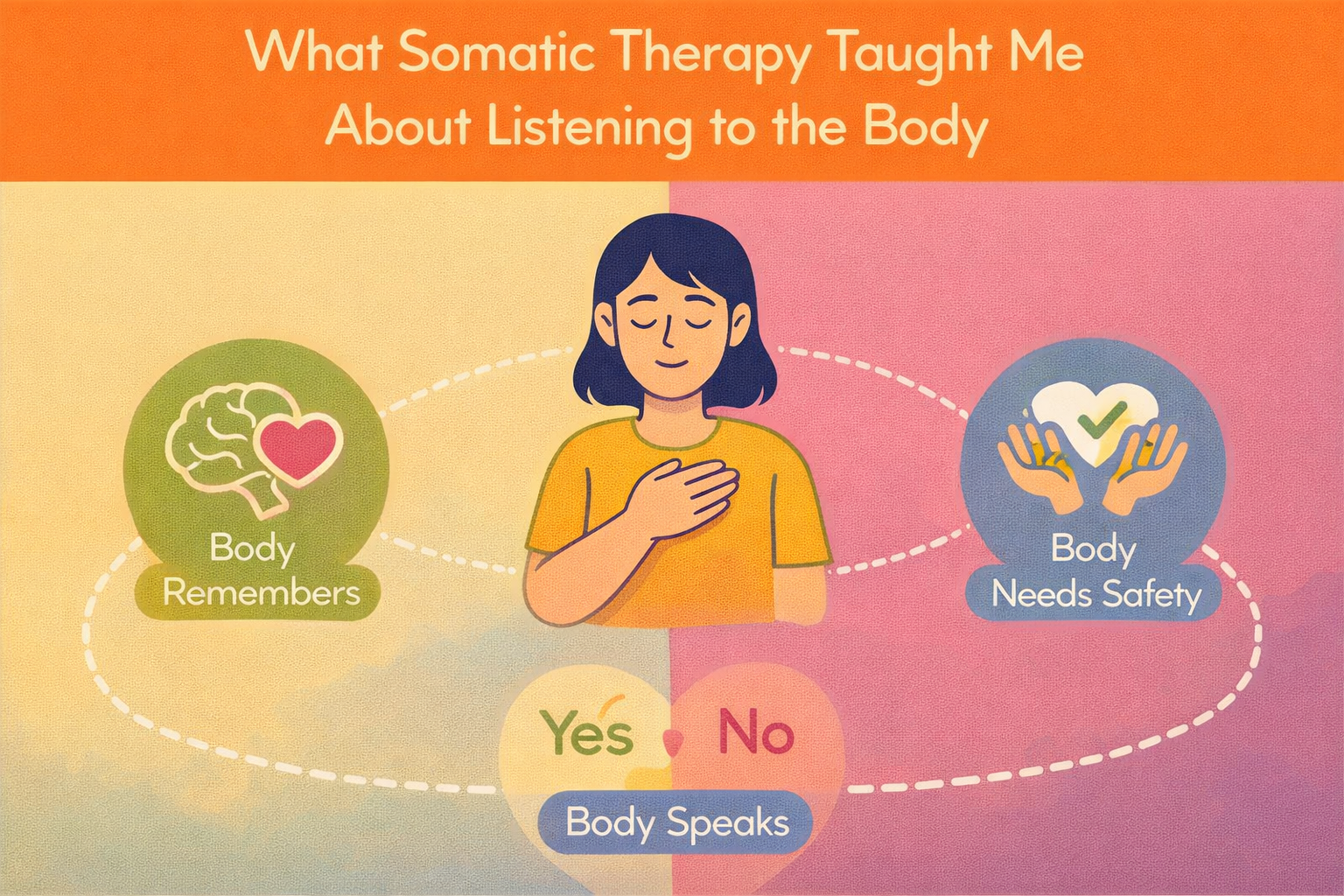
The Body Remembers What the Mind Forgets
One of the first things I discovered was that the body carries stories long after the mind has buried them.
- A tight chest during conflict.
- A lump in the throat when speaking up.
- A heaviness in the stomach before making a decision.
These sensations aren’t random. They are the body’s language — echoes of past experiences, protective responses, and unspoken truths. Somatic therapy taught me to stop dismissing them as “just stress” and instead ask, “What is this sensation trying to tell me?”
Small Sensations Carry Big Wisdom
Trauma often disconnects us from our bodies. For many, being in the body can feel unsafe, overwhelming, or even unbearable. Somatic therapy doesn’t push for instant embodiment. Instead, it starts gently — noticing the smallest of sensations: the weight of your feet on the ground, the texture of fabric on your skin, the rise and fall of your breath.
These simple anchors remind us that we can come back, bit by bit, without being consumed. It taught me that healing doesn’t require grand gestures. Sometimes, it begins with noticing something as subtle as a warm hand resting on your lap.
The Body Speaks in “Yes” and “No”
Through somatic exploration, I learned that the body often signals boundaries more clearly than words do. A tightening, a pulling back, a sudden urge to freeze — all ways the body says “no.” A softening, an opening in the chest, a deeper breath — signs of “yes.”
This has been one of the most profound lessons: learning to trust these cues instead of overriding them with logic, guilt, or external expectations. Somatic therapy reminded me that boundaries don’t only live in the mind — they live in the body too.
Safety is Felt, Not Declared
Before somatic work, I thought safety was about external circumstances: a locked door, a supportive person, a calm environment. And while those matter, I came to understand that true safety is something the body feels.
Safety is the moment your nervous system softens, when hypervigilance eases, when your body believes it is okay to rest. Without this felt sense, even the best coping strategies may fall flat. Listening to the body allows us to find and nurture those islands of safety, however small they may be.
Healing Is Not Just About Talking — It’s About Noticing
Perhaps the most humbling lesson somatic therapy offered me is that healing doesn’t always come through words. Sometimes, it comes through a breath that finally flows freely. A muscle that lets go after years of holding. A tear that arrives when the body feels safe enough to release it.
Somatic therapy taught me that the body isn’t just where pain lives — it’s also where resilience, wisdom, and healing reside. When we learn to listen, we open a pathway not just to survival, but to wholeness.
A Closing Reflection
What somatic therapy ultimately taught me is that listening to the body isn’t about fixing or controlling it — it’s about honoring it. Our bodies carry not just our wounds, but also our wisdom, creativity, and capacity for joy.
When we turn toward the body with curiosity instead of criticism, we begin to reclaim parts of ourselves that may have felt lost. Healing, then, becomes less about “getting rid” of pain and more about learning to live in relationship with ourselves — fully, gently, and authentically.
Your body has a voice. The more we listen, the more it teaches us what it means to come home to ourselves.