

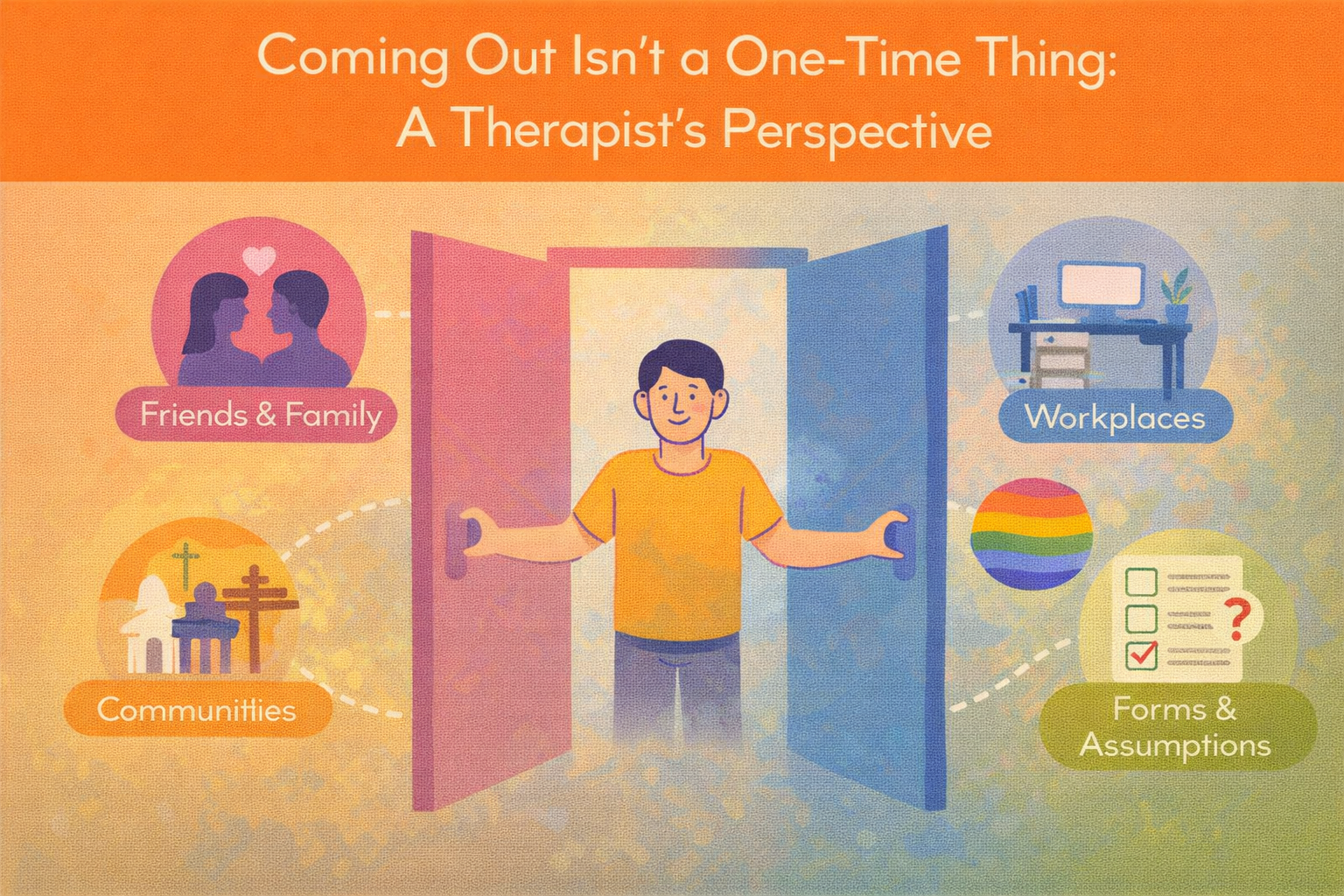
COMING OUT ISN’T A ONE-TIME THING: A Therapist’s Perspective
When we talk about coming out, we often picture it as a defining moment — a brave declaration, a door opening into a new, freer life. And while that version exists for some, it’s far from the full picture. For many queer folks, coming out isn’t one big moment. It’s a series of choices, often repeated, sometimes exhausting, and almost always shaped by context, safety, and survival.
Coming out isn’t just about saying the words — it’s about navigating a world that often demands explanations, justifications, or silence.
The Many Layers of Coming Out
Coming out happens in layers:
- To oneself
- To close friends and family
- In professional spaces
- In public or unfamiliar settings
- Within cultural or religious communities
- Even within queer spaces, when navigating multiple identities (race, gender, disability, neurodivergence, etc.)
And none of these are linear. A person might be out in one context but not another, or may have to “re-come out” again and again due to assumptions, erasure, or safety concerns. But even after that internal shift, coming out doesn’t end. It happens again and again:
- Every time someone assumes your partner is of a different gender.
- Every time you’re filling out a form and none of the boxes fit.
- Every time you’re at a family gathering and decide whether or not to correct a comment.
- Every time a job interview or a landlord makes you question if being out is safe.
It’s not just emotional labor — it's a survival strategy.
The Emotional Weight
Coming out can be deeply liberating, but it can also be lonely, scary, and risky. Some people lose relationships, face discrimination, or are met with silence where they hoped for support. Others might experience conditional acceptance — “We still love you, but just don’t talk about it,” which can sting just as much as rejection.
There’s also the pressure to “have it all figured out.” But identity isn’t always static. People may come out as gay, and later as bi or pan. Someone might explore gender fluidity, then embrace being non-binary. Fluidity is human — but it’s often met with skepticism or invalidation, even within LGBTQ+ spaces.
The world wants neat labels and confident answers. But coming out is often filled with questions, not certainties.
Cultural and Contextual Complexity
Coming out in India — or in any context where family, community, and social harmony are deeply valued — can add another layer of complexity. It’s not just about self-expression; it’s about navigating expectations, obligations, and fears around what it might mean for one’s parents, siblings, or extended family.
For many, being out is a privilege — one that isn’t always available, especially in environments that are unsafe, unsupportive, or violently homophobic or transphobic.
In therapy, I’ve heard stories of people who have stayed closeted to protect their housing, education, or access to healthcare. I’ve also heard stories of people who came out, only to face emotional blackmail, isolation, or pressure to “change.”
You’re Not Alone
If you're reading this and navigating the complexities of coming out — whether you're just beginning to question, or you've been on this journey for years — I want you to know: your experience is valid. Your feelings are valid. And your pace is valid.
There is no universal roadmap. No ideal timeline. No perfect words.
Coming out can be joyful, heartbreaking, liberating, terrifying — sometimes all at once. And while it may be an ongoing process, you deserve support, community, and care every step of the way.
A Gentle Reminder
If you’re navigating your own coming out journey, know this:
You don’t owe anyone your story.
You are allowed to take your time.
Your identity is real — whether it’s spoken aloud or held quietly in your heart.
And you deserve spaces where you are seen, affirmed, and safe.
As therapists, our role is to help create those spaces. To bear witness. To affirm. And to walk beside you, however and wherever your journey unfolds.