

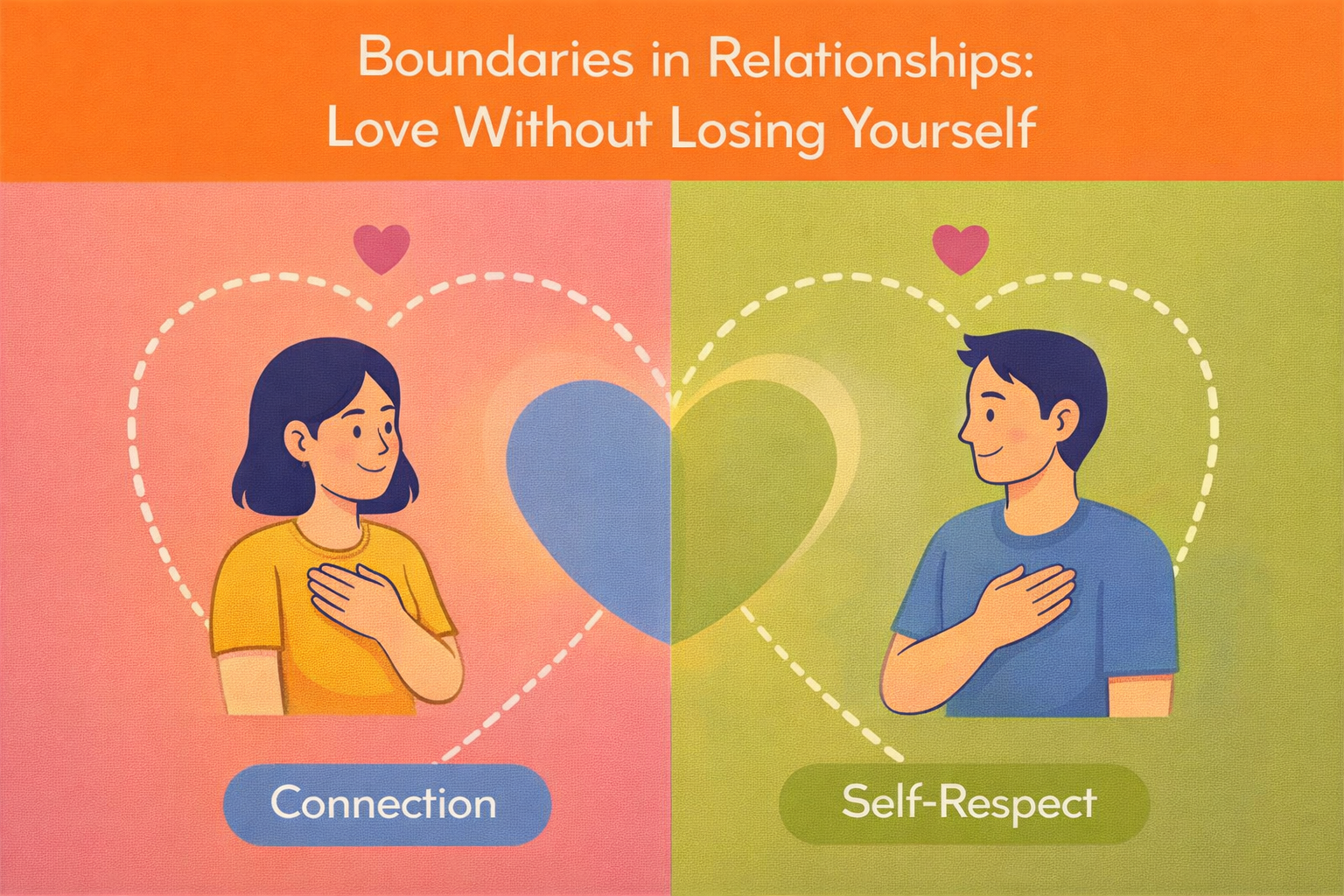
Boundaries in Relationships: Love Without Losing Yourself
For a long time, I thought love meant closeness — answering every call, being endlessly available, giving without pause. I believed that being a “good” partner or friend meant saying yes, understanding always, and never needing too much in return.
But over time, I began to notice a quiet truth beneath the surface: the more I tried to be everything for others, the further I drifted from myself. I wasn’t unloving; I was unanchored.
How I Learned What Love Without Boundaries Can Do
I remember times when I said “yes” even though every part of me wanted to say “no.” Times when I absorbed someone else’s pain as if it were my own. Times when silence felt safer than honesty.
It came from a good place — from wanting to be kind, supportive, available. But underneath it all was fear. Fear that setting limits would make me unlovable. Fear that space meant distance. Fear that if I chose myself, I’d lose the connection.
In truth, I was confusing love with merging.
The Turning Point
It took therapy — both as a client and as a therapist — to understand that boundaries aren’t about separation; they’re about safety. Not just safety from others, but safety with ourselves.
I began to notice how my body would tense when I ignored my limits, how my chest would tighten when I agreed to something I didn’t have space for. The exhaustion that followed wasn’t just physical; it was emotional depletion — the cost of abandoning myself to maintain closeness.
Over time, I realized:
Love without boundaries isn’t love — it’s overextension. Real love doesn’t require self-erasure.
What Healthy Connection Feels Like
The most transformative relationships I’ve known — both personal and therapeutic — are the ones where both people have room to exist fully. Where honesty doesn’t threaten the bond, and space doesn’t mean rejection.
Healthy connection feels like exhaling.
- It’s when “no” is received with understanding, not withdrawal.
- It’s when both people can take responsibility for their emotions instead of carrying each other’s entirely.
- It’s when presence feels chosen, not obligated.
In those moments, love becomes something deeper — rooted not in need, but in respect.
What Boundaries Have Taught Me
Boundaries have taught me that:
- Saying “no” can be an act of care, not cruelty.
- Distance can deepen connection when it’s rooted in honesty.
- Respecting my limits allows me to show up more fully when I am present.
- The right people won’t be scared of your boundaries — they’ll feel safer because of them.
Most importantly, boundaries have taught me that loving others well begins with loving myself enough to stay whole in the process
A Closing Reflection
These days, I no longer see boundaries as lines that divide. I see them as the structure that allows love to stand.
Because love isn’t meant to consume you — it’s meant to expand you.
And when you learn to hold both connection and self-respect in the same breath, love becomes what it was always meant to be: a place where two people can meet, not merge.