

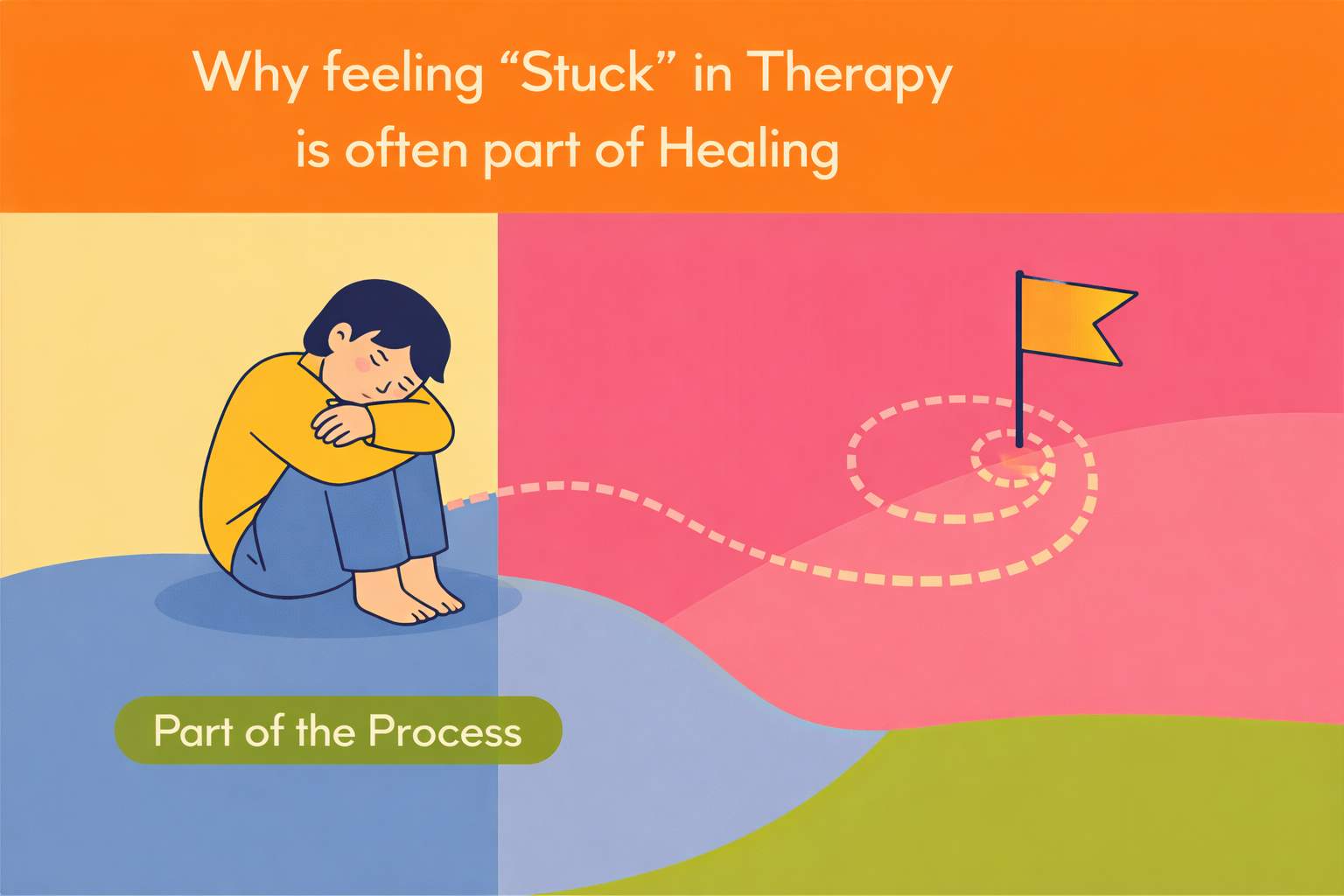
Why feeling “Stuck” in Therapy is often part of Healing
Have you ever sat in a therapy session thinking “Why am I not moving forward” or “I feel stuck…is something wrong with me” or “Why is it going around in circles?”, you’d be surprised to find out that you’re not alone. This feeling is far more common than most people realise and can sometimes also be a sign that something meaningful is happening beneath the surface.
Therapy isn’t linear- a straight upward climb. It is a slow, layered and deeply personal process. Just like how physical healing involves rest, discomfort and plateaus before you regain your strength, healing in therapy also moves through such phases- sometimes fast, sometimes painfully slow and sometimes in spirals.
Let’s explore why feeling stuck in therapy is not just normal but can sometimes also be necessary.
- Feeling Stuck often means you’ve reached a deeper layer
Most people, when they first come to therapy, begin with a surface level story: the parts they can easily name, describe or rationalise. As therapy progresses, you start approaching and exploring the roots of the longstanding patterns- early childhood experiences, emotional wounds or internal conflicts that have been protected and buried for years.
When you reach these deeper layers, it’s natural for your nervous system to slow down.
Maybe let’s think of it as standing at the edge of a deep pool. You can’t jump in the way you would with a shallow one. Your body pauses, assesses and prepares. That pause can feel like stuckness, but it can be your mind’s way of saying “This feels important. Let’s go slow”. What looks like “stuck” is often a protective layer and not a failure of therapy or lack of effort.
- Your Nervous System needs time to catch up
Therapy isn’t just a conversation- it’s a physiological process
When you explore emotions, beliefs and memories, your nervous system is involved. Insight may come quickly, but integration- the part where your body actually feels safer or more open- takes time. Most of the time, your mind cognitively understands something before your body does. This creates a gap that feels like being stuck.
For example:
- You may realise intellectually that a relationship pattern is unhealthy but still feel emotionally attached.
- You may understand why anxiety shows up, but your body still reacts the same way.
This is not resistance- it’s your system regulating itself at its own pace. Slowing down allows you to integrate change safely, without overwhelming your emotional capacity.
- Stuckness can signal an Internal Conflict
Many people come to therapy wanting change, but another part of them quietly fears what change might mean. This doesn’t make you contradictory; it makes you human.
Feeling stuck can reflect:
- Fear of losing familiar coping strategies
- Fear of confronting painful truths
- Fear of disappointing others
- Fear of who you might become if something finally shifts
When two parts of you are pulling in different directions, therapy naturally pauses. This pause is an invitation to be curious: “What part of me is scared right now?” Bringing compassion to these conflicting parts is itself a significant step toward healing.
- You may be in a Rest Phase; which is productive
In nature, seasons change. Trees don’t grow all year. There are months where they appear barren, yet underground, their roots strengthen.
Human healing mirrors this.
After emotionally heavy sessions or breakthroughs, you may unconsciously pull back, feel stuck, or feel like you have “nothing to say.” This is not avoidance. It is consolidation.
A rest phase gives your mind time to absorb insights, re-evaluate old patterns, and prepare for the next step.
Progress that looks still is still progress.
- Stuckness can be an opportunity- one where you can repair with your therapist
Therapy is not just about the issues you bring — it’s also about the relationship you build with your therapist.
Feeling stuck gives you a chance to:
- Express frustration
- Explore expectations
- Understand relational patterns
- Practice vulnerability
- Strengthen trust
Bringing stuckness into the room can deepen the therapeutic alliance, because you learn that you can express difficult feelings and still be held safely. Sometimes the most transformative sessions begin with:“I don’t know what’s happening, but I feel stuck.”
- Growth doesn’t always look like what you expect
We often imagine healing as breakthroughs, clarity, confidence, and consistent upward momentum. But real healing includes: Slowness, Silence, Confusion, Repetition, Setbacks and Plateaus.
Sometimes you are rewriting years of conditioning- not in one session, but layer by layer. The parts of you that learned to shut down, overfunction, avoid, or numb out need time to unlearn. Feeling stuck is a natural part of this re-learning.
What matters is not how fast you’re moving, but the direction you’re moving in.
- What to do when you feel stuck
Here are a few gentle steps that can help:
- Tell your therapist exactly how you’re feeling (you don’t have to deal with it alone). Naming the stuckness often beings movement
- Reflect on what might feel scary about moving forward. Be curious, not critical. Ask yourself, “What might this stuckness be trying to show me?”
- Notice any shifts outside of the sessions, even the smaller ones. They often happen outside of the therapy room.
- Allow your pace. Healing isnt a race, it’s rebuilding a relationship with yourself.
- Give yourself compassion. You’re doing something brave- even when it feels slow.
Feeling stuck in therapy doesn’t mean you’re failing or going in circles.
It means you’re human.
It means something important is unfolding beneath the surface.
It means you’re approaching a place that deserves gentleness, time, and patience.
So the next time you catch yourself thinking, “Why am I not moving forward?”, remember:
You are.
Just more slowly.
More deeply.
More honestly than you realise.
Healing isn’t linear and that’s not just okay, It’s part of the process.