

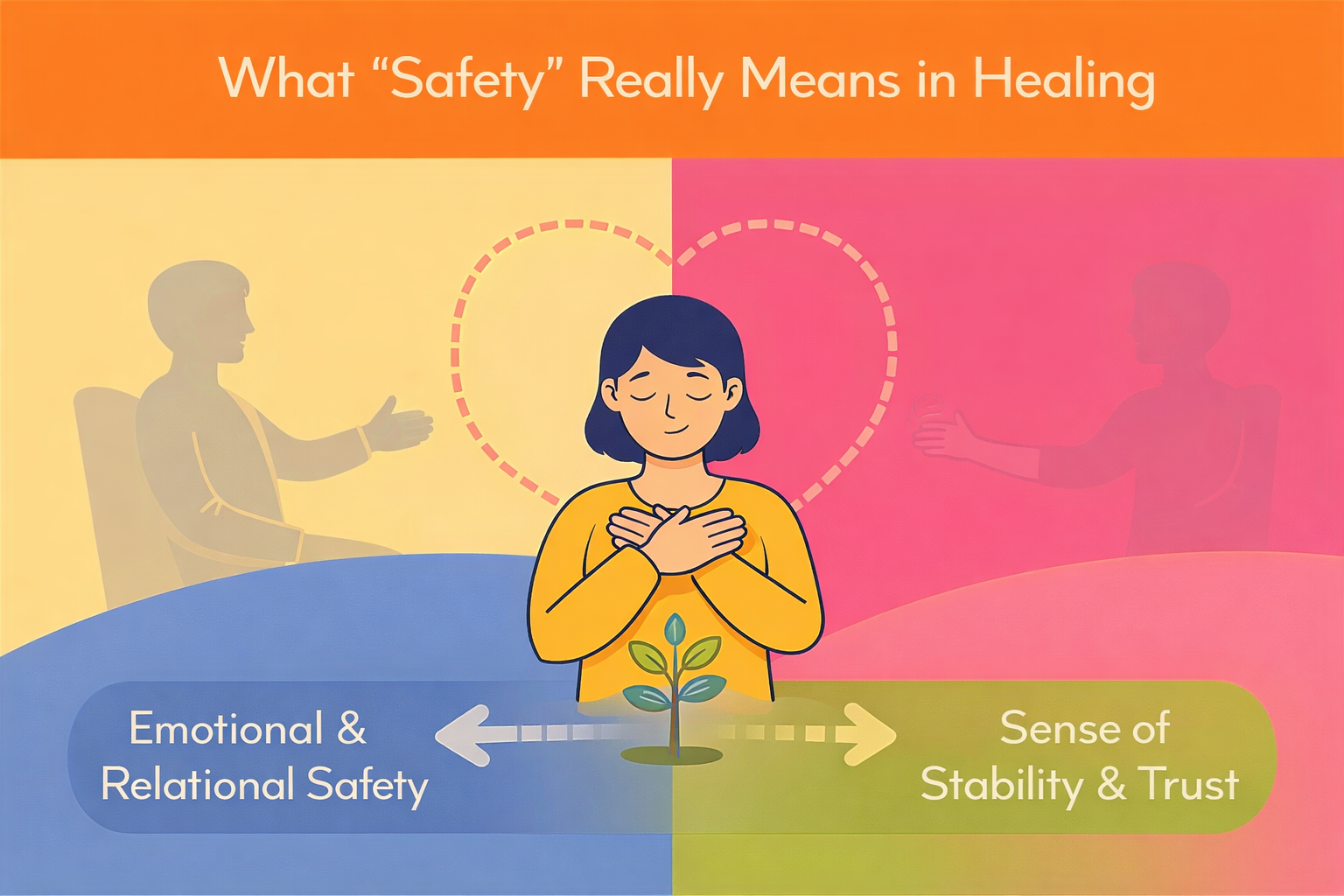
What “Safety” Really Means in Healing
When we talk about healing from trauma, the word safety comes up often. But for many people, safety isn’t something that has ever felt steady or reliable. It might have meant staying quiet to avoid conflict, shrinking to stay invisible, or always staying alert, just in case.
In therapy, when we ask “Do you feel safe?”, it’s not only about physical safety. It’s also about whether your body and mind believe that you are safe. And for someone who has lived through fear, uncertainty, or instability, that belief takes time to rebuild.
Contrary to popular belief, safety isn’t simply the absence of danger. Many people think of safety as simply being away from harm- having a roof over your head, being physically secure. However, emotional and relational safety go much deeper. But what do they mean and how would you know that they exist?
Emotional safety means being able to share what you feel- the sadness, anger, fear, or confusion, without fearing judgment, rejection, or dismissal. Many people grow up in environments where emotions were ignored or punished, so expressing them can feel risky. In therapy, emotional safety develops slowly through consistency and gentleness. When a therapist holds space for your feelings without rushing you to “move on” or “stay positive,” it teaches your body that emotions can be safe to feel.
Relational safety is about learning that connection doesn’t have to mean danger or loss. For those who’ve been hurt in any relationship, trusting again can feel terrifying. Therapy becomes a place to be able to rebuild that trust, to see that boundaries are respected, that you can be honest without consequence, and that someone can stay even when things feel messy.
Together, emotional and relational safety form the ground on which healing stands- helping you not only understand your experiences but also feel safe enough to exist fully within them.
For someone healing from trauma, both can feel unfamiliar. The body may stay tense even in calm situations. You might find yourself waiting for something to go wrong, or struggling to relax even when nothing bad is happening. That’s because your nervous system has learned that the world isn’t predictable and unlearning that takes time.
Safety as Something We Rebuild, Not “Achieve”
One of the first goals in therapy is not to feel “fully safe” - that’s a high bar. But to feel safe enough. Safe enough to pause. To notice your breath. To let yourself feel something small without running from it.
Safety, in this sense, is not a destination you reach; it’s a process you slowly build. In therapy, that process often begins with consistency- showing up week after week to a space where you are met with warmth and steadiness.
From a therapist’s lens, every small moment of trust matters. When a client shares something difficult and we stay present rather than rush to “fix” it, that’s a moment of safety being rebuilt. When we check in before exploring something painful or respect a client’s “not yet,” it reminds their nervous system: This time, I’m in control. This time, I get to decide.
Over time, these moments accumulate. What begins as an external sense of safety within the therapy room slowly turns inward into a felt sense of I can handle this. I’m safe enough right now.
The Body’s Role in Safety
Safety isn’t something you can simply think yourself into. You can tell your mind, “I’m fine,” but if your body doesn’t believe it, you might still feel uneasy or disconnected.
That’s why trauma-informed therapy often brings attention to the body- through grounding, movement, or simple awareness exercises. It’s not about forcing calm but about helping your nervous system learn that it doesn’t have to stay in survival mode at all times.
Something as small as feeling your feet on the floor, taking a slow exhale, smelling something or noticing the rhythm of your breath can signal to your body: I’m here. I’m okay right now.
At first, this can feel strange. For some, even calmness can feel unsafe because it’s unfamiliar. The body may have learned that this is the “calm before the chaos”. So when peace finally arrives, it can trigger old alarms. That’s not regression; that’s your system relearning what safety actually feels like.
Safety and Relationships
For many people, trauma happens in relationships, whether it is through betrayal, neglect, or harm, by those who were supposed to protect them. It’s no surprise, then, that relationships can also feel unsafe even long after.
Healing, however, happens through relationships too. Therapy becomes one such relationship which can become a space to test what it’s like to be seen and accepted without fear or judgement. When clients realize that they can show their authentic selves- the messy, quiet, angry, or unsure selves and still be met with compassion, it opens a doorway for deeper healing.
Outside of therapy, rebuilding relational safety might mean noticing who helps your body soften rather than tense up. It might mean setting boundaries, even with people you love. Or allowing yourself to receive support without guilt.
Each of these choices tells your system: It’s okay to take up space now. It’s okay to trust, little by little.
Safety as the Foundation for Growth
Safety doesn’t mean you’ll never feel triggered again. It doesn’t mean life will always feel calm. It means that when things feel shaky, you’ll have a stronger sense of how to steady yourself.
True safety is not the absence of threat; it’s the presence of connection- to yourself, your body, and others who remind you that you’re not alone. It’s knowing you can pause before reacting, reach out when you need support, and choose spaces that feel nurturing rather than draining.
As therapists, we often think of safety as the soil from which healing grows. Without it, nothing can take root. With it, even the smallest shifts: a breath, a boundary, a truth spoken aloud, can begin to flourish.
So, what does safety really mean in healing?
It’s the slow, patient rebuilding of trust: with yourself, with others, and with the world.
It’s learning that you don’t have to stay guarded forever.
And one day, it’s the quiet realization that safety isn’t something you need to keep searching for, it’s something you’ve begun to carry within