

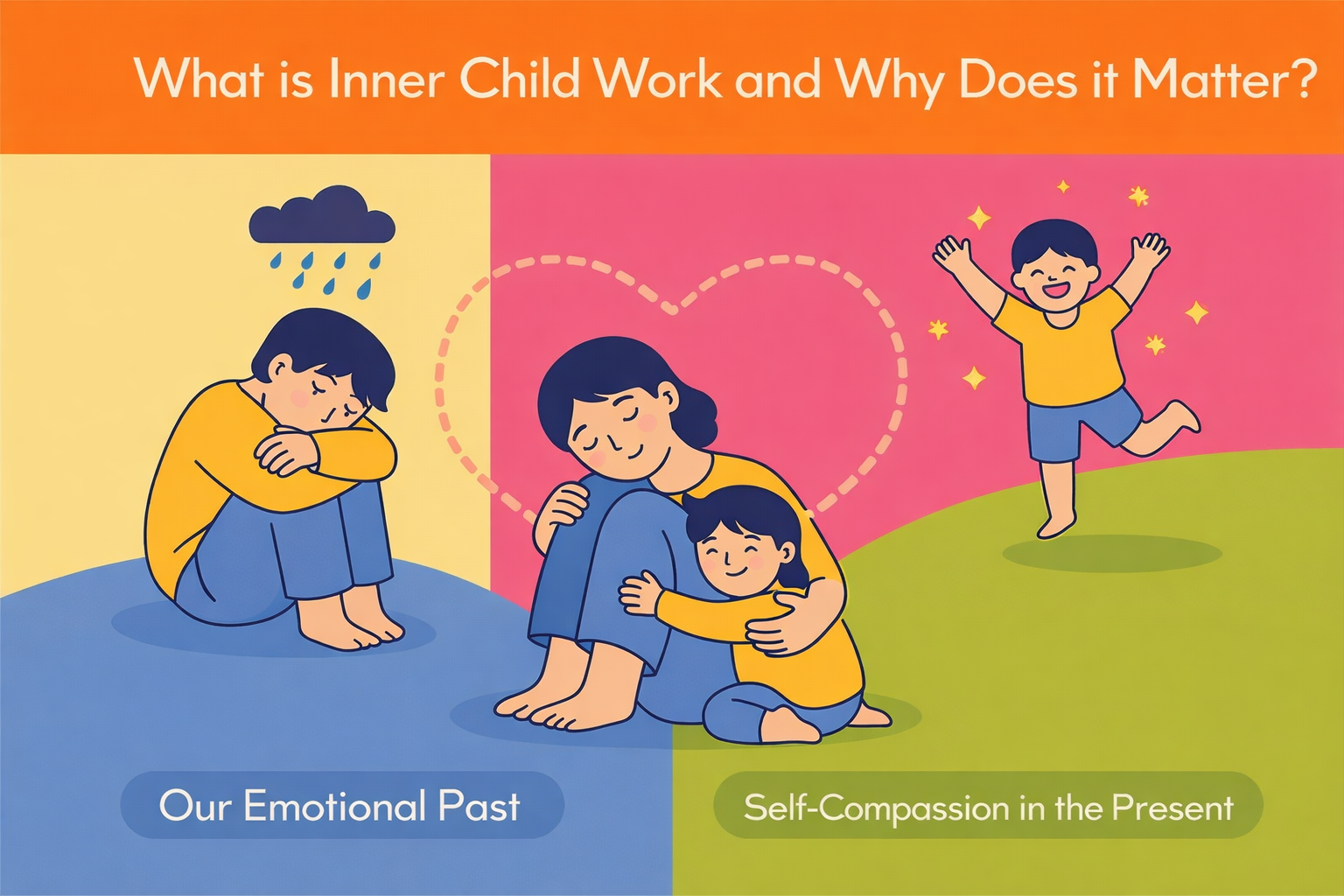
What is Inner Child Work and Why Does it Matter?
The idea of an “inner child” may sound abstract at first, almost like something pulled from a self-help meme. But when you sit with the concept a little longer, it starts to make real emotional sense. Inner child work is not about imagining a literal child sitting inside you. It’s about recognising that every adult carries traces of who they once were: the curious parts, the playful parts, the fearful parts, and also, the wounded parts. Those early emotional experiences don’t disappear just because we grow older; they shape how we feel, respond, trust, love, and protect ourselves in the present.
The inner child represents the emotional imprint of your early years- your experiences of love, safety, connection, validation, boundaries, and comfort. If your needs were mostly met as a child, you likely developed emotional safety, secure attachment, and trust. But if those needs were ignored, minimised, or inconsistently met, they may show up in adulthood in ways that feel confusing or overwhelming. You may logically understand a situation, yet find yourself reacting emotionally in a way that feels much younger than your age.
For example, maybe you panic when someone doesn’t text back, not because you’re needy, but because once, silence meant abandonment. Maybe criticism feels unbearable, not because you’re fragile, but because growing up, love and approval felt conditional. Or maybe you struggle to set boundaries- not because you lack discipline, but because somewhere along the way, you learned that pleasing others was safer than expressing needs. These responses are not flaws or weaknesses; they are patterns shaped by earlier environments where you adapted to survive emotionally.
This is why inner child work matters. It helps bridge the gap between awareness and emotional integration. Understanding your patterns intellectually is helpful, but it doesn’t always create change on its own. The nervous system remembers what the mind tries to move past. Inner child work offers a way to meet those emotional memories with compassion instead of avoidance, and curiosity instead of judgment.
Importantly, inner child work is not about blaming caregivers or resenting the past. Many parents did the best they could with the emotional capacity and tools they had. Instead, this work is about acknowledging the reality of what you needed then and learning how to offer some of that support to yourself now. When we begin to recognise our emotional triggers through this lens, reactions that once felt irrational start to make sense. You move from “What’s wrong with me?” to “What happened to me?” and that shift alone can soften self-criticism and reduce shame.
Reconnecting with your inner child doesn’t require dramatic emotional breakthroughs. Often, it begins quietly by noticing your responses with more kindness. Instead of reacting with frustration toward yourself, you might pause and ask: “Which younger part of me is activated right now? What did I need back then that feels unmet now?” That gentle inquiry can create emotional space where there used to be automatic reactivity.
This process may also involve learning new emotional skills you didn’t have access to when you were younger likevalidating your feelings, expressing needs, setting boundaries, or allowing yourself to rest without guilt. Sometimes it looks like grieving what you didn’t receive. Other times, it looks like offering yourself small moments of connection, through play, creativity, laughter, softness, or stillness, that reconnect you with parts of yourself that became quiet or hidden over time.
Over time, inner child work can create meaningful shifts. Relationships may feel less overwhelming. Conflict may feel less threatening. Self-worth may become steadier, less dependent on approval or performance. Instead of constantly trying to earn love, you may begin to believe you are worthy of it. Instead of avoiding emotions, you learn to sit with them. And instead of reacting from old wounds, you gradually start responding from a grounded, present place.
Healing the inner child isn’t about becoming someone new rather it’s about becoming someone who no longer abandons themselves. It’s about offering the compassion, protection, patience, and care you once needed and may have never received in the way you deserved.
A Gentle Reflection
Take a moment and complete these three sentences without thinking too much:
- A part of me still feels afraid to…
- As a child, I needed someone to say…
- Today, I can offer myself…
Let your answers be honest, imperfect, and human.
That’s where healing begins- not with perfection, but with recognition. And with time, your inner child won’t feel like a silent memory- you’ll begin to feel them soften, trust, and rest.