

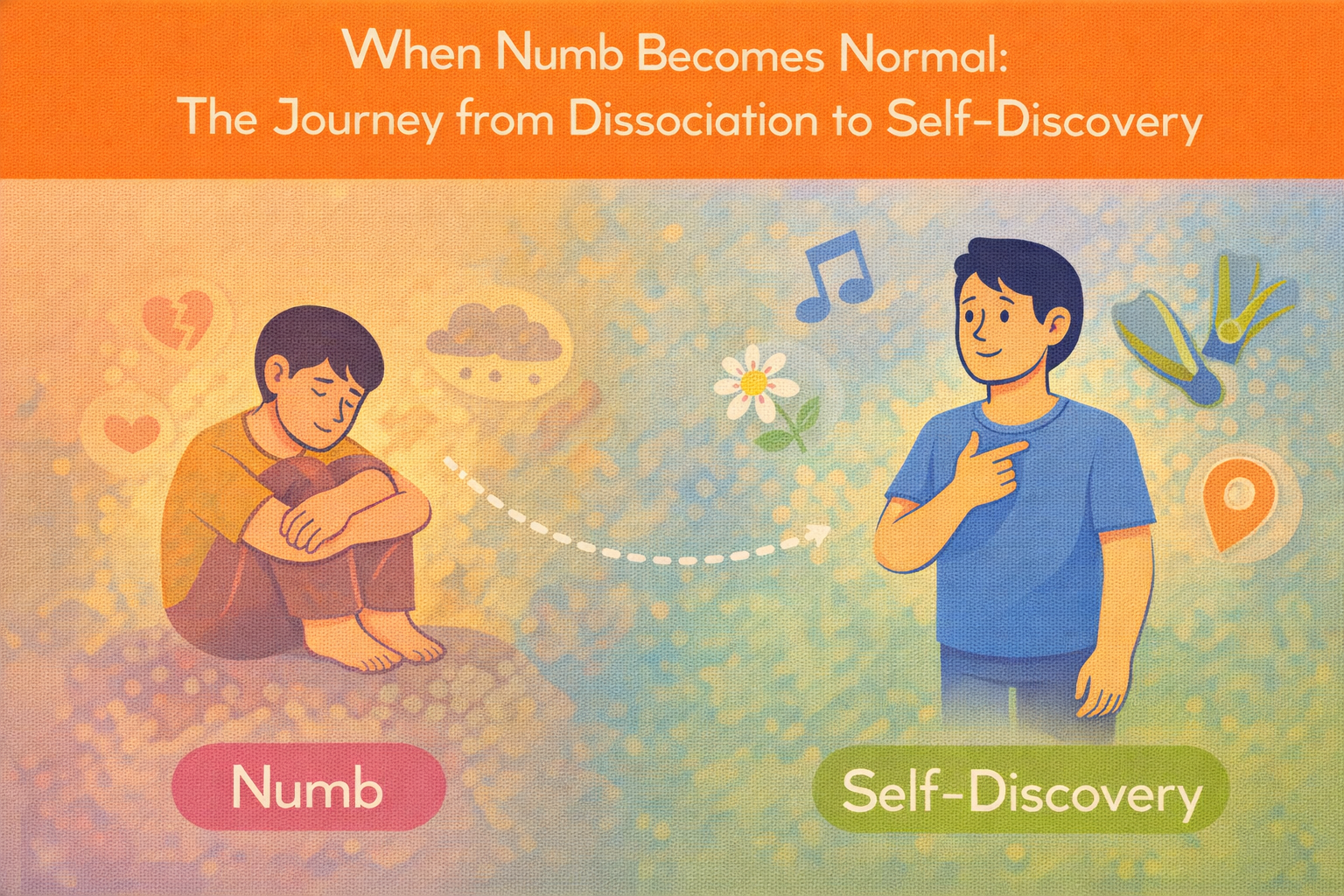
When Numb Becomes Normal: The Journey from Dissociation to Self-Discovery
There was a remark made by a client in a session that sparked a chain of thoughts and led me into a reflective space.
It was a simple remark: “I don’t know what I like.”
Mind you, the context of this remark was around self-needs and identity — that deep question of who am I when I’m not what others expect me to be?
When you experience childhood trauma, you often learn to dissociate. Dissociation is a form of disconnection — from thoughts, feelings, memories, or even bodily sensations. Over time, it can leave you with very little sense of self, like you’re living life slightly out of focus.
To broaden this idea, imagine spending your entire childhood numbing yourself just to cope with difficult experiences at home. The thing about numbing is — it’s not selective. It doesn’t only protect you from the painful things; it mutes everything. It doesn’t just numb you in one environment — it numbs you everywhere.
So, you grow up, move through life, maybe build relationships or a career, and then one day — often in therapy — you begin reconnecting with your emotions. You start to feel again.
And yes, that sounds like a breakthrough — and it truly is. But what follows can often be confusing, disorienting, even lonely. Because when you start feeling again after years of emotional numbness, you don’t just feel the good stuff. You feel everything — all at once.
Why does this happen? Because your baseline for understanding your emotions, your needs, and your identity never really got the chance to develop. You were surviving, not discovering. And when survival mode is all you’ve known, peace can feel strange, joy can feel suspicious, and emptiness can feel like home.
But hey — great news. Truly.
After that heavy realization comes the gift: you get to find yourself, this time with awareness, patience, and compassion.
And it can actually be fun.
What makes it fun is recognizing that you’re now discovering your own baseline — your emotional fingerprint. Things might overwhelm you, both positively and negatively. But that’s how you grow, recalibrate, and start shaping your authentic sense of self. (Yes, it’s basically a fancy way of saying “trial and error,” but these are important words to hear.)
So go take that jiu-jitsu class. Try swimming. Ask questions. Mingle. Hug someone and notice how it feels — maybe you’ll realize you actually like hugging after all.
Because that’s the thing — you learn who you are by living.
There will be ifs and buts along the way, and I promise, each one has a logical explanation.
You start right where you are — and that’s more than enough.