

I Touch Grass: Everyday Grounding for Calm
Many clients call it distraction in therapy. We call it grounding.
Grounding is anything that helps you feel calm, present, and connected to reality. It’s the skill of anchoring yourself when your mind wants to spiral into the past, jump into the future, or get lost in overwhelming feelings.
And here’s the good news: grounding isn’t only for therapy sessions. It’s something you can use in daily life, anytime, anywhere.
Why Grounding Matters
As human beings, we’re high-functioning multitaskers. Our brains juggle constant streams of thoughts, emotions, decisions, and problem-solving. No wonder it gets overwhelming.
Grounding offers a pause button. It helps your nervous system slow down, your mind clear up, and your body feel safe again.
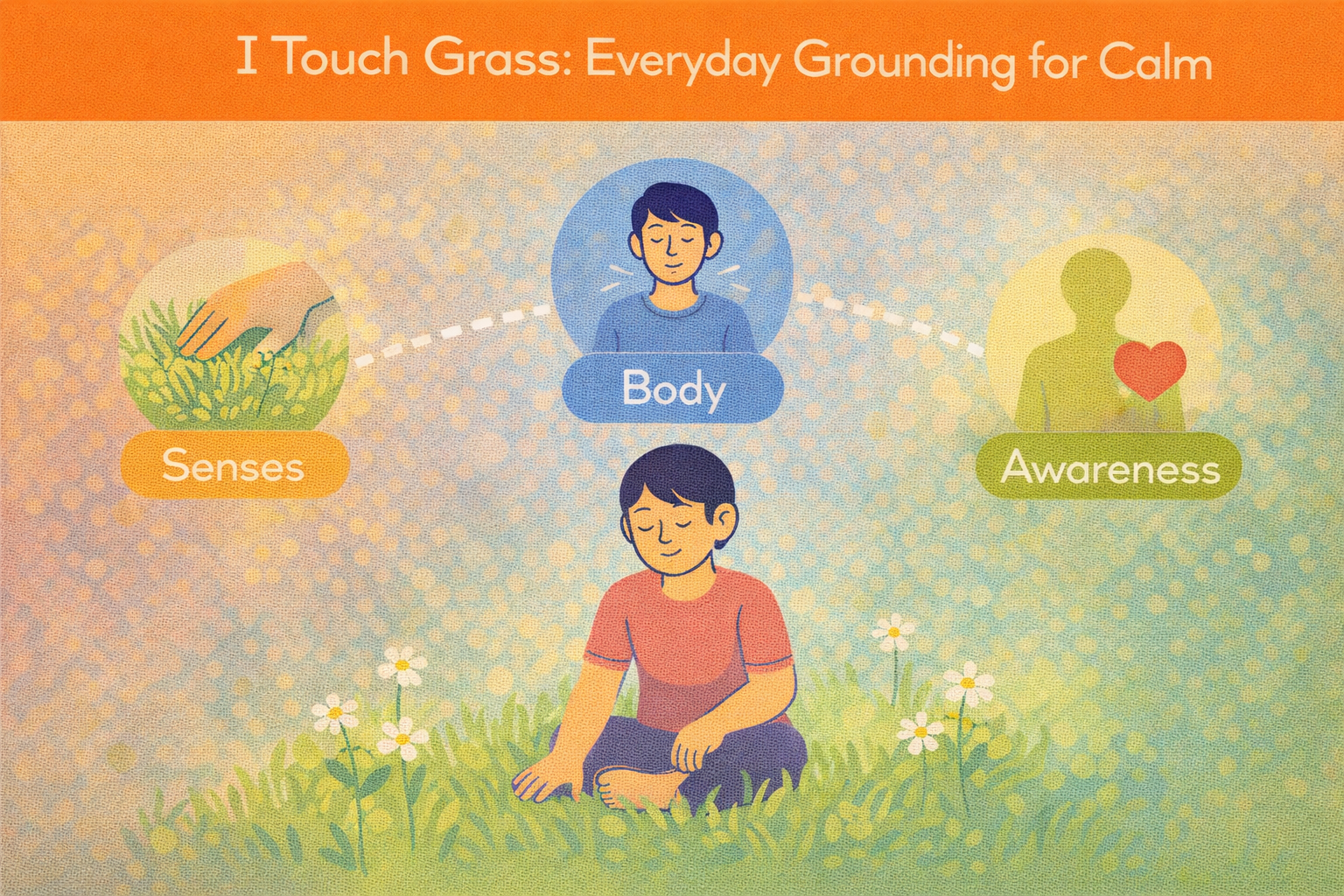
There are many ways to ground—but most involve three elements:
- Senses → tuning into sight, touch, taste, smell, sound
- Body → connecting with physical sensations
- Awareness → checking in with emotions and where they live in your bod
Emotional Check-Ins
One of the most underrated grounding tools is simply asking yourself:
- What am I feeling right now?
- Where do I feel it in my body?
Our bodies give us clues—anger might bring heat to your face, sadness might weigh on your chest, anxiety might tighten your stomach.
Once you identify the emotion, try rating it on a scale from 1–10. This helps you measure intensity, notice patterns, and track progress when you use grounding techniques.
Practical Grounding Techniques
Here’s a toolkit of grounding strategies. You don’t have to use them all—experiment, combine, and see what works best for you.
Sensory Grounding
- 5-4-3-2-1 Technique
Notice 5 things you see, 4 you can touch, 3 you hear, 2 you taste, 1 you smell. A simple but powerful way to pull yourself back to the present. - Drinking Something Cold or Warm
Sip cold water, a sweet drink, or even warm tea. Temperature and taste are grounding sensations that instantly bring your awareness back. - Walking Barefoot
Step onto the ground, feel the coolness, texture, or even tiny grains of dirt. Your feet are packed with sensory receptors that connect you with reality. - Being Outside
Simply sitting outside or riding in a vehicle with the breeze on your face can shift your energy and help you breathe deeper
Body-Based Grounding
- Self-Hug
Wrap your arms around yourself and hold. This pressure signals safety to your nervous system. - Hugging & Rocking
Take it further by hugging yourself in different positions and gently rocking side to side. Movement adds extra comfort. - Touch Therapy (Body Scan)
Scan your body from toes to head. Place your palm where you feel tension—like your chest or stomach—and hold. - Forehead & Neck Rocking
Place one palm on your forehead and the other at the back of your neck, then gently rock forward/backward or sway side-to-side for about 30 seconds. This combines grounding touch with soothing movement
Breathing & Nervous System Soothers
- Box Breathing
Inhale 4 sec → Hold 4 sec → Exhale 4 sec → Hold 4 sec → Repeat. A steady rhythm to reset your system. - Vagal Nerve Massage
Gently pull the tops of your ears and massage down to your earlobes for a couple of minutes. This stimulates your vagus nerve, calming fight–flight–freeze. - Peaceful Music + Breath
Put on calming music and breathe with it—matching your inhales and exhales to the rhythm. Music plus breath is a double grounding effect
Movement
- Shimmy, Stretch, Clap, Tap
Shake your body, stretch your arms, clap your hands, or tap your thighs. Movement releases stuck energy. - Exercise or Chores
Sports, dancing, cleaning, even folding laundry—all of these engage the body and redirect restless energy.
Creating Safe Spaces
Sometimes, your environment itself triggers distress. When that happens, having a personal grounding spot is key.
It could be a chair, a room, a cozy blanket, or a corner of your home. Train your body to associate this spot with calm—when you sit there, you know it’s time to breathe and reset.
Spiritual Grounding
If you find comfort in prayer, chanting, or meditation, let that be your anchor. Spiritual grounding can be just as powerful as physical or sensory techniques.
Your Personal Grounding Experiment
Grounding isn’t a one-size-fits-all practice. For some, it’s touching grass. For others, it’s humming to music, drinking cold water, or walking barefoot.
Think of grounding as an experiment—try different practices, notice how your body responds, and keep the ones that truly help you return to the present.
The more you practice, the easier it becomes to access calm—whether you’re in therapy, at work, or just navigating daily life.