

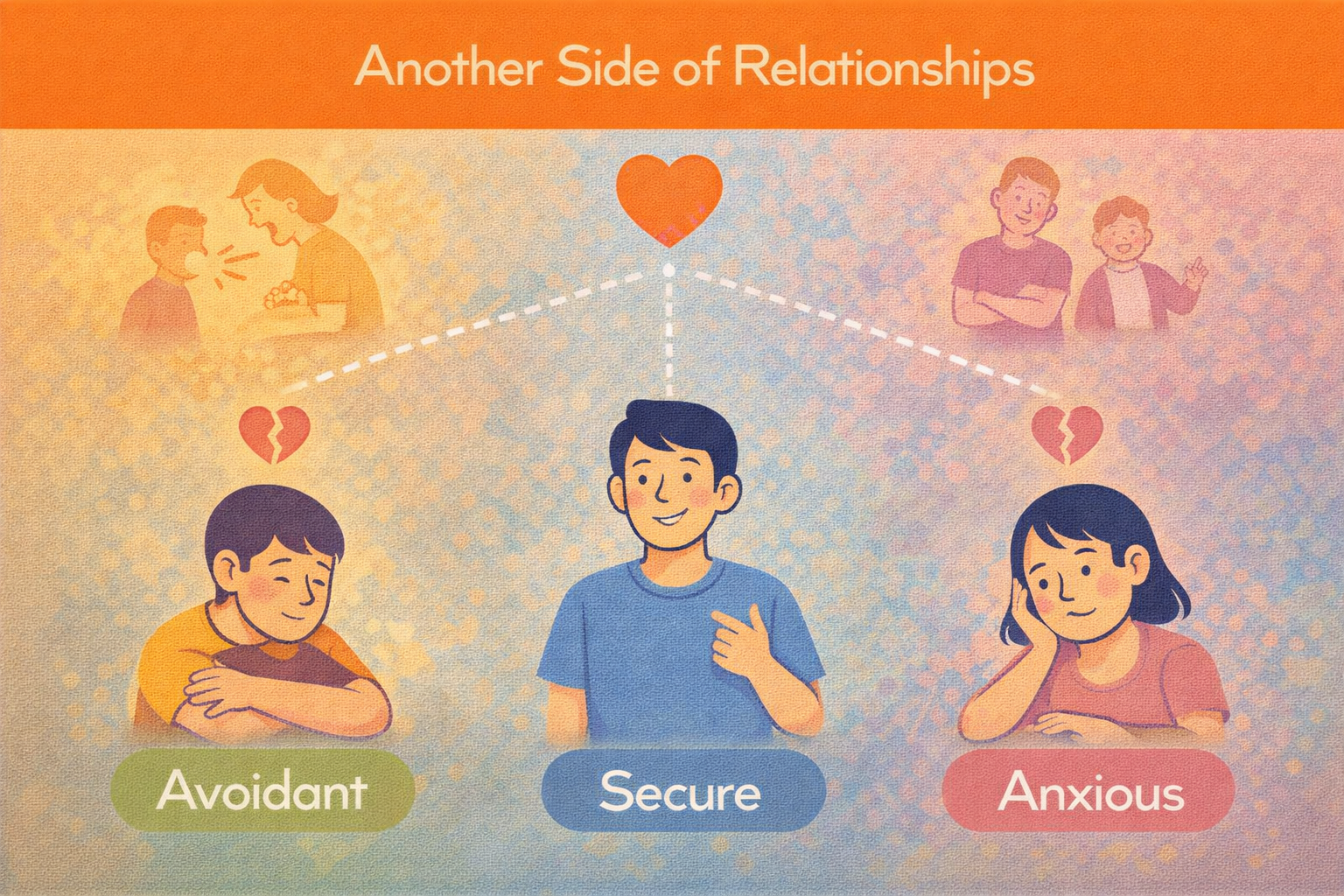
Another Side of Relationships
If you’ve ever found yourself scrolling through relationship posts on Instagram or chatting with friends about love and attachment, chances are you’ve heard words like avoidant, anxious, or secure. These terms get thrown around a lot — but what do they actually mean? And why do we behave the way we do in relationships?
Let’s unpack this step by step.
Where It All Begins: Parenting and Early Attachment
Our journey into attachment doesn’t start with our first romantic relationship — it starts much earlier, in childhood. The way we’re raised, the kind of love and boundaries we experience, and how our caregivers respond to us — all of it quietly shapes the way we connect with others later in life.
Psychologist Diana Baumrind talked about three main parenting styles that set the stage for our emotional world: authoritative, authoritarian, and permissive.
- Authoritative parents are the balanced ones — warm, supportive, and open to discussions, yet firm when it comes to setting boundaries. Kids raised this way often grow up feeling secure, responsible, and confident to express themselves.
- Authoritarian parents, on the other hand, lead with control and rules. There’s less emotional warmth and more “because I said so.” Children from these homes often struggle with low self-esteem, anxiety, or may rebel as they grow older.
- Permissive parents mean well — they’re warm and loving, but often say “yes” to everything. Boundaries are blurry, and children end up having to make decisions they’re not ready for. As adults, they might struggle with impulsivity or find it hard to handle limits.
These early dynamics become the soil from which our attachment styles grow.
Growing Up: Attachment in Adulthood
John Bowlby, a pioneer in attachment theory, explained how our early experiences with caregivers form an internal working model — basically, a blueprint for how we expect relationships to feel. But the good news? We’re not stuck with it forever. As we grow, reflect, and heal, we can develop new ways of relating to others.
Mary Ainsworth later described three main adult attachment styles: secure, anxious, and avoidant.
- Securely attached adults are comfortable with closeness. They trust others, communicate openly, and believe that relationships can be stable and fulfilling. They’re not afraid to rely on someone, and they don’t panic when someone relies on them.
- Anxiously attached adults crave closeness but fear rejection. They often worry that their partner doesn’t love them enough or will leave. Their relationships can feel like emotional roller coasters — intense, consuming, and sometimes short-lived.
- Avoidantly attached adults are the ones who often say, “I don’t need anyone.” They value independence so deeply that closeness can feel uncomfortable. They struggle with trust, find it hard to be vulnerable, and may pull away when things start to get emotionally intimate.
People with avoidant attachment often grew up in homes where affection was limited, where emotions weren’t freely expressed, or where they were encouraged to “toughen up.” So, they learned early on that relying on others wasn’t safe — that it’s better to handle things alone.
Connecting the Dots
So, when we talk about avoidance in relationships, it’s not about being cold or heartless — it’s often about protection. For someone with avoidant tendencies, closeness might trigger a deep fear of being hurt or losing control. It’s a defense mechanism, shaped long before they ever fell in love.
Understanding where this comes from can help us bring compassion into our relationships — both with others and with ourselves. Because when we understand our attachment style, we gain the power to change it.
The Takeaway
We’re all shaped by the love we received — or didn’t — as kids. Our parents’ warmth, control, and responsiveness became the foundation for how we now give and receive love. But here’s the beautiful part: no attachment style is fixed. With awareness, therapy, and safe relationships, we can all learn to move toward security — toward a love that feels calm, open, and connected.