

Trauma Healing and Inner Child Work
Trauma Healing and Inner Child Work: A Beginner’s Guide to Understanding and Reconnecting with Your Inner Self
People generally attribute trauma to big events such as war, an accident, etc. While it’s true, it’s not all that trauma encapsulates. Often, it forms quietly, over time and can go unnoticed, especially in childhood. It can come in the form of inconsistent caregiving, emotional neglect, unsafe environments, or experiences that taught us to suppress our emotions to survive, such as constant criticism. These childhood wounds shape how we think, behave, and relate to ourselves and others as adults.
This realisation often leads us to ask: “Does it mean I am irrevocably broken, and is this how life will look like forever?” A simple answer to it is: No. That’s because there’s nothing broken in the first place. These responses are learned survival mechanisms, and just like they were learned, they can be unlearned as well, gradually over time.
One powerful method in healing trauma is Inner Child Work. This is a process that helps us reconnect with the parts of ourselves that were wounded, silenced, overlooked, agitated, etc. when we were young. It’s not about dwelling on the past, but about understanding, nurturing, and integrating the younger self within us so we can live with greater emotional freedom in the present and going ahead.
So, what exactly is the Inner Child?
The “inner child” is a psychological concept which refers to the part of our subconscious that holds our earliest experiences, emotions, memories, and needs which went unmet. It can represent both:
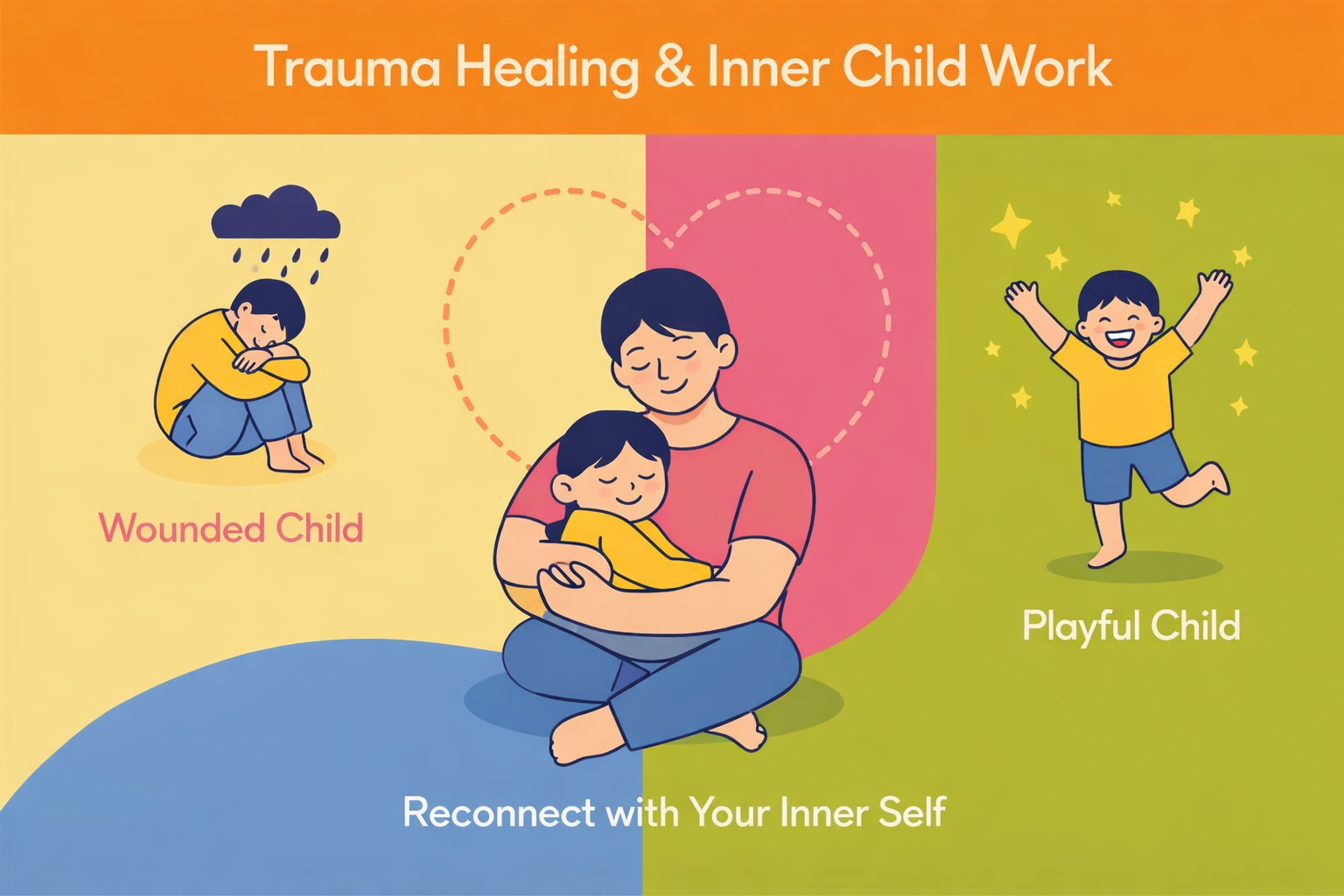
The wounded child: carrying pain, fear, shame, or unmet emotional needs
The playful child: holding joy, curiosity, creativity, spontaneity
So, our inner child is essentially a symbolic representation of the emotional traces from our formative years. These early impressions profoundly influence our adult selves’ identity, self-esteem, emotional regulation, and relationships.
Some examples of the traces from our formative years which can form are:
- If you grew up being criticised often, your inner child may still believe, “I am not good enough.”
- If you were told that you were adorable in the formative years, your inner child would believe that they are adorable, leading to healthy self-esteem
- If you learned to stay quiet to avoid trouble, your inner child may still fear expressing needs or setting boundaries.
- If comfort was inconsistent or absent, your inner child may feel unsafe or easily overwhelmed.
- If you were encouraged to be yourself and celebrated for your unique qualities during your formative years, your inner child may still carry the belief that you are worthy of love, acceptance, and admiration just as you are.
Inner child work can therefore help us meet these fears and unmet needs with the compassion, safety, and validation we may not have received in the past.
Let’s understand a bit more about how childhood trauma can shape the Inner Child
Childhood is the time when the brain, body, and emotional systems are rapidly developing and thus learning. Trauma during this time, whether it be emotional, physical, relational, environmental, etc., can leave lasting imprints that continue into adulthood.
Some common signs of an inner child affected by unresolved trauma include:
- Feeling overly responsible for others
- Difficulty trusting people
- Fear of abandonment or rejection
- Low self-worth or harsh self-criticism
- Emotionally shutting down or dissociating
- Chronic people-pleasing
- Trouble identifying or expressing feelings
- Self-sabotaging behaviours
- Feeling unsafe even in safe situations
Many adults don’t realise that these patterns originate from a younger version of themselves who adapted to survive. The goal of inner child work is not to erase these patterns or memories associated with them but to understand them and help the inner child feel safe enough to release the emotional charge they carry.
Why Inner Child Work Helps in Healing Trauma
Inner child work is powerful because it:
- Reconnects You With Suppressed Emotions: Children often can’t articulate or process painful experiences, especially when they aren’t taught how to. These emotions get stored in the body and their subconscious, which resurface later as anxiety, numbness, anger, avoidance, self-blame, depression, etc. Validating those emotions now can help release what was once too overwhelming.
- Builds Self-Compassion: Trauma often leaves a person feeling ashamed or “not enough.” So, when you understand that many of these feelings originate from a child who had no control over their environment and experiences, it becomes easier to replace self-blame with compassion.
- Helps Break Old Patterns: Many adult patterns, such as choosing unavailable partners, fearing conflict, or overworking to earn approval, etc., stem from childhood coping mechanisms. Here, inner child work helps you recognise these links and gently shift them.
- Creates a Sense of Internal Safety: Healing happens when the nervous system feels safe. Re-parenting your inner child can provide the younger self with the emotional safety they never had, and this, in turn, allows the adult self to feel grounded in the present.
So, what are some ways to start Inner Child work?
Inner child work doesn’t require special tools, nor does it have to be too intense. The following beginner-friendly strategies can help to reconnect with the younger self gently.
- Identify Your Inner Child’s Voice: Start by noticing when your reactions seem “child-like”, without naming them as immature or with negative judgment, but rather emotionally intense or deeply vulnerable. Some of these moments to observe can include: Feeling overly hurt by criticism, fear when someone pulls away emotionally, panic when making mistakes, wanting to hide or shut down during conflict, etc.
You can ask yourself: “How old do I feel right now?” when these intense reactions come about. This simple question can help you recognise when your inner child is triggered and reaching out for support.
- Write a Letter to Your Inner Child: This is one of the most effective tools for reconnection and self-discovery. Write to your inner child as if they are sitting across from you. In this letter, you can reassure them, validate their feelings, and offer the safety they lacked. One example of doing this would be writing something on the lines of:
“You didn’t deserve to feel alone. I see how hard you tried. I’m here now, and you’re safe with me.” This exercise builds trust and thus a safe relationship with the inner child, which subsequently and gradually can reduce the inner child’s sense of abandonment.
- Explore Childhood Memories (Without Forcing Anything): Please note that in case doing this step leads to more intense emotional and body reactions, it’s best to do it in the presence of a therapist, rather than alone.
To explore these memories, you can think about:
- Places you felt safe or unsafe
- Moments when you felt happy, afraid, excited, or misunderstood
- The rules in your household
- How conflict was handled
- The roles in the household
Here, you can reflect gently on those moments without analysing them, as the inner child work is mainly about feeling, understanding, and then responding to them with compassion and safety rather than judging and reliving those painful memories.
- Practice Re-Parenting: Re-parenting means giving yourself the support now that you needed back then. This support can come in various forms, including emotional, behavioural, or even physical/ somatic exercises.
Examples of what that support can look like are as follows:
Emotional: Saying, “It’s okay to feel this. I’m here for us.”
Physical: Resting when you’re tired, eating when hungry, calming your body with breathing or doing certain exercises like stretching.
Behavioural: Setting boundaries, saying no, choosing safe relationships.
The core of reparenting and creating the safety within can be encapsulated with remembering this: You become the adult your younger self needed.
- Engage in Play or Creativity: When we grow up, people often have the notion to not engage in play as it may seem “childish”. Now that is not true. Integrating some play in adult lives is also very crucial, especially for trauma survivors, as many trauma survivors lose touch with joy or spontaneity. To do this, you can try activities your younger self loved, such as:
- Drawing
- Singing
- Dancing
- Playing games
- Watching childhood movies
- Visiting places you enjoyed growing up
This can reconnect you with your authentic self and restore emotional balance when you need it.
What’s important to note is that inner child work is a lifelong journey and not a quick fix. It requires unconditional love, compassion, patience, and consistency. Revisiting that inner child and exploring their pain with curiosity doesn’t mean you’re “going backwards”. It means you are supporting and thus reclaiming the parts of yourself that were left behind.
Healing your inner child allows you to live with more freedom, emotional stability, and self-love. It softens old wounds, breaks unhealthy patterns, and builds a stronger, more compassionate relationship with yourself and, thereby, others as well, eventually.
Point to reflect on: Your inner child has always been with you, but it’s only waiting to be seen, heard, and held. And healing truly begins the moment you decide to listen.