

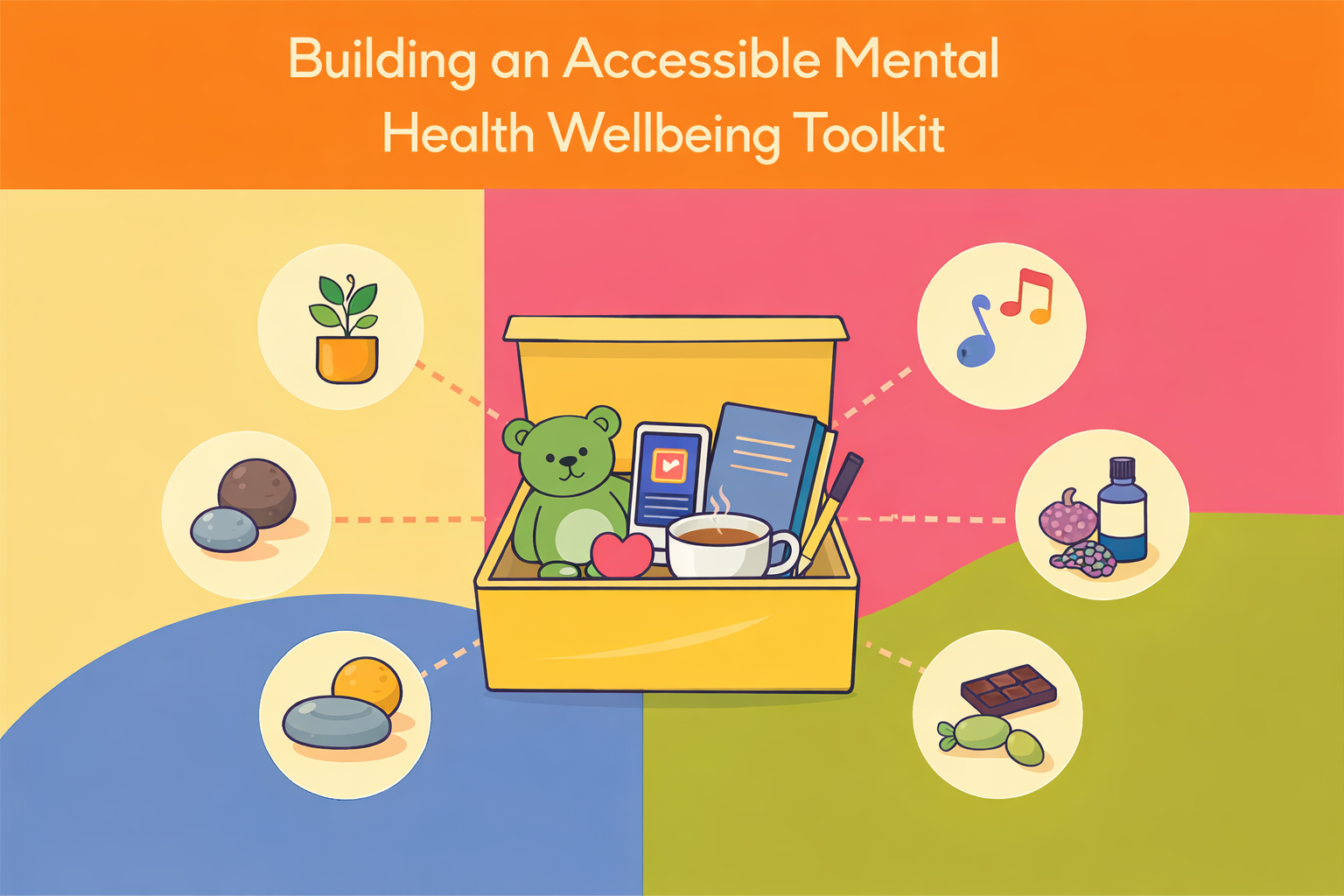
Building an Accessible Mental Health Wellbeing Toolkit
We all have days when life feels a little too heavy, our thoughts get noisy, or stress takes over. In those moments, it helps to have something we can turn to, such as a set of tools and comforts that remind us that we are the ones in control. That’s what we call a mental health wellbeing toolkit.
Think of it as a first aid kit for your mind and emotions. Just like you’d keep plasters and antiseptics handy for cuts and scrapes, your wellbeing toolkit is there for times when you need grounding, soothing, or a gentle lift. And the best part? It’s entirely yours to design.
A wellbeing toolkit is a collection of items, activities, or reminders that help you manage stress and support your mental health. It can live in a box, a drawer, a bag, or even on your phone. It just needs to be accessible and meaningful to you.
By creating one, you’re giving yourself agency, which is the power to choose how you respond to tough moments rather than feeling stuck or helpless.
How to Build Your Toolkit:
A simple way to start building the toolkit is through thinking of our five senses and incorporating at least one tool per sense. So, in total there needs to be at least 5 tools in the toolkit. Each sense can hold something comforting, grounding, or energising. Some ideas to spark your own tools are as follows:
Sight:
- A favourite photo, postcard, or artwork
- A small plant or calming image
- A vision board that reminds you of hope and possibility
- An object which can feel soothing, such as a crystal, jewellery
You can ask yourself: What do I love looking at when I need to feel calmer or lighter?
Sound:
- A playlist of songs that soothe or energise you
- Nature sounds (rain, ocean waves, birds chirping)
- Recorded affirmations which can be found online or can be self-recorded
- A voice note from a loved one
- Carrying a small bell
- Soothing tones like singing bowls
A question which could help: Which sounds shift my mood in the direction I want it to go?
Smell:
- A candle or essential oil (lavender, citrus, peppermint)
- A sachet of dried herbs or flowers
- A coffee or tea blend with a comforting aroma
- Carrying perfume or a small bottle of ‘itra’
Reflective question: Which scents bring me a sense of calm or ease?
Taste:
- Herbal tea for relaxation
- A small treat like chocolate or mints
- A snack that feels nourishing and familiar
- Carrying small fennel seed packets
Question that could help: What flavours remind me of comfort or energy?
Touch:
- A soft blanket or scarf
- A fidget toy, stress ball, or smooth stone
- Something grounding like sand, clay, or putty
- Feeling the texture of the wall or the sofa.
- Natural textures of sand, water, etc.
Asking this could help tailor the experience: What textures help me feel more present in my body?
Your toolkit doesn’t have to stop with sensory items. You can also include activities/ tools beyond the 5 senses. Some of the other ways are:
- Journaling with online prompts if needed or affirmations (E.g. “Among all of the tough days I’ve had, I’ve survived through them all, and I can do this one too.”)
- Breathing or grounding exercises, which you can write on a small card to carry
- A short movement idea (stretch, walk, dancing to a song, humming/singing)
- A connection list with names of people you can reach out to when you need support
It’s important that the toolkit is tailored to you in a way to make it work for you. So, some pointers to remember are as follows:
- Keeping it simple: you don’t need dozens of items. Start with one or two for each sense.
- Making it accessible: keep it somewhere you’ll remember and can reach for, especially when you are distressed. This means, creating a toolkit which would allow you to access it even when you are outside of your home.
- Update it: your needs may change over time, so you can always swap things in and out, and edit it the way you see fit.
Note: there’s no “wrong” toolkit. If it helps you, it belongs, and that’s all we need.
Building your wellbeing toolkit is more than just a nice exercise. It’s a way of reminding yourself that: “I have tools. I have choices. I can support myself.” This sense of agency, especially during difficult moments, can make all the difference.
Closing questions you can ask to help tailor it to you: What activities or reminders help you feel most like yourself again? If you could add just one item to your wellbeing toolkit today, what would it be, and why