

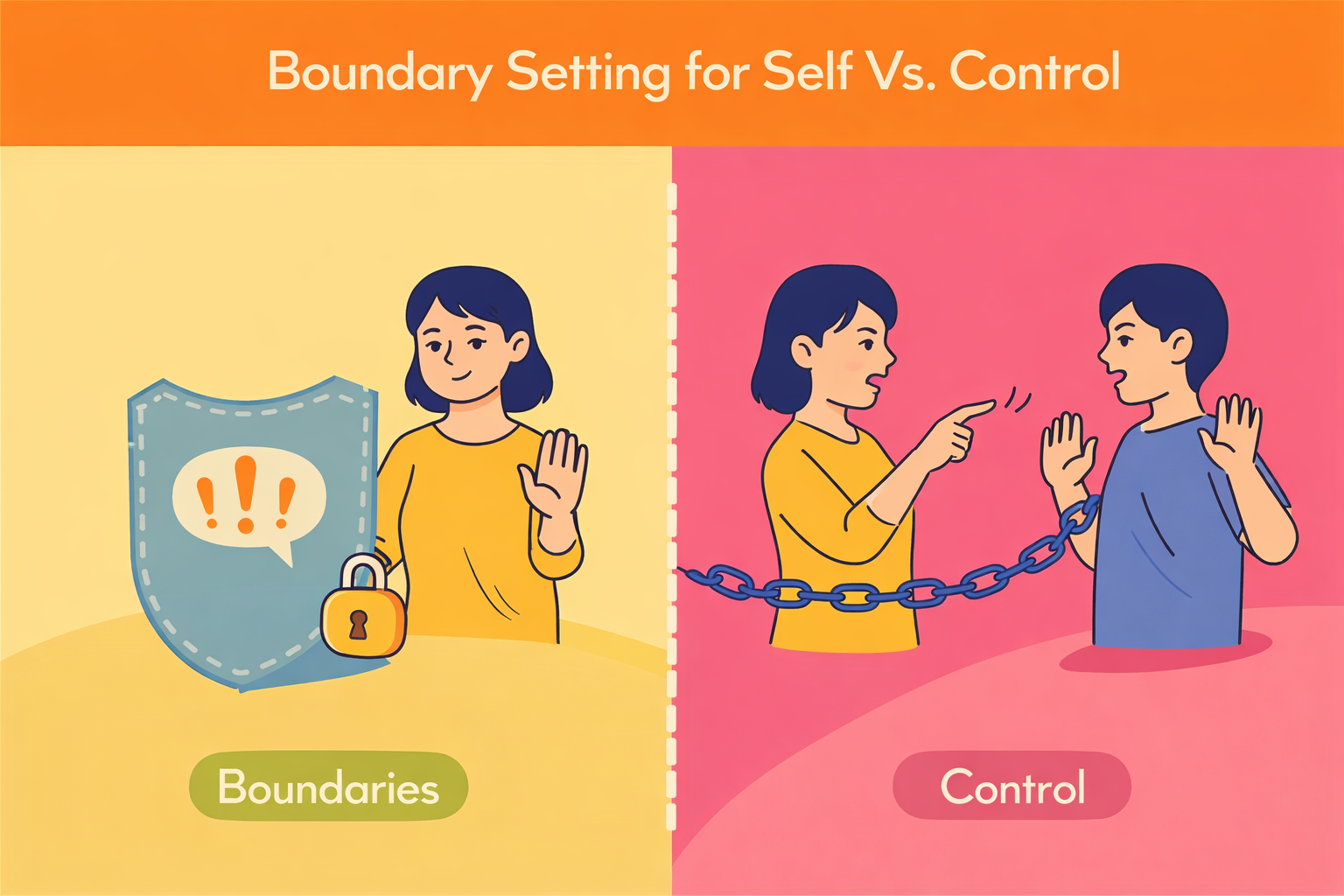
Boundary Setting for Self Vs. Control
‘Boundaries’ have become a buzzword in recent years due to their presence in social media posts, videos, and so on. While most of us have heard the word, do we truly understand what they are? The uncomfortable truth is that even with the best of intentions, many confuse setting boundaries with trying to control other people’s behaviour. At first, the difference between them may seem subtle, but it’s that difference which can lead to either empowerment or frustration. Boundaries can often masquerade as control, which can lead to more conflict than healthy relationships, along with the issue of failing to uphold them. So let’s first distinguish what boundaries and control are.
A boundary, at its core, is about oneself and not the other. It’s the limit we set to protect our values, energies, time, well-being, etc. They are not about changing others, but more about what we can and can’t accept and in the event that the boundary is crossed, how we would respond to them.
An example of this is, if Person A values rest and they know they’d get anxious when they are sleep-deprived, they can set a boundary by stating to Person B who potentially calls them at any time, “Hey, I won’t be available for phone calls after 10 p.m. because I need to get enough rest.” Here, noticing how this focuses more on needs, choice and own action of not picking up the call rather than Person B’s behaviour. So boundaries are self-directed and are more of a declaration of how we would take care of ourselves in case certain conditions arise.
On the other hand, the place where things go wrong is when establishing boundaries is confused with control. Here, rather than focusing on oneself, in control, they try to dictate or manage another person’s behaviour, which creates a power struggle and resentment. An example of this is, let’s say Partner A is uncomfortable going out with Partner B late at night with friends. Here, a control response would be: “We shouldn’t go out after 11 p.m.” This is more of a rule imposed on oneself as well as Partner B. However, a boundary response may look like this: “I feel anxious when plans extend too late into the night. If that happens often, I might choose to head home earlier or spend that time differently for my own well-being.” So here, the focus shifts from restricting their freedom to what Partner A will do. This way, Partner B is free to make their choices, and Partner A can retain autonomy in deciding how to protect their peace.
The confusion between boundaries and control arises due to their similarities in expressing limits, but they differ in the locus of responsibility/ control. Many people default to control as it feels easier, as say, if someone changes their behaviour, it may feel uncomfortable. However, the issue arises as this externalises responsibility, where instead of managing our own choices and responses (i.e. focusing on internal locus of control), we place the burden on others to regulate our feelings. So, when control masquerades as a boundary, it usually fails as people either push back or comply resentfully, and the mistaken “boundary” becomes a recurring source of tension rather than clarity and safety.
Finally, an easy way to distinguish is: Boundaries are about ownership of self, about me and what I will do or not do, whereas control is ownership of others, about you and what I want you to do or not do. So the next time we set a boundary, we can ask ourselves:
- Am I trying to change the other person’s behaviour, or am I clarifying my own?
- Does this statement describe what I will do rather than what they must do?
- If the other person never changed, could I still follow through on this boundary for my own well-being?