

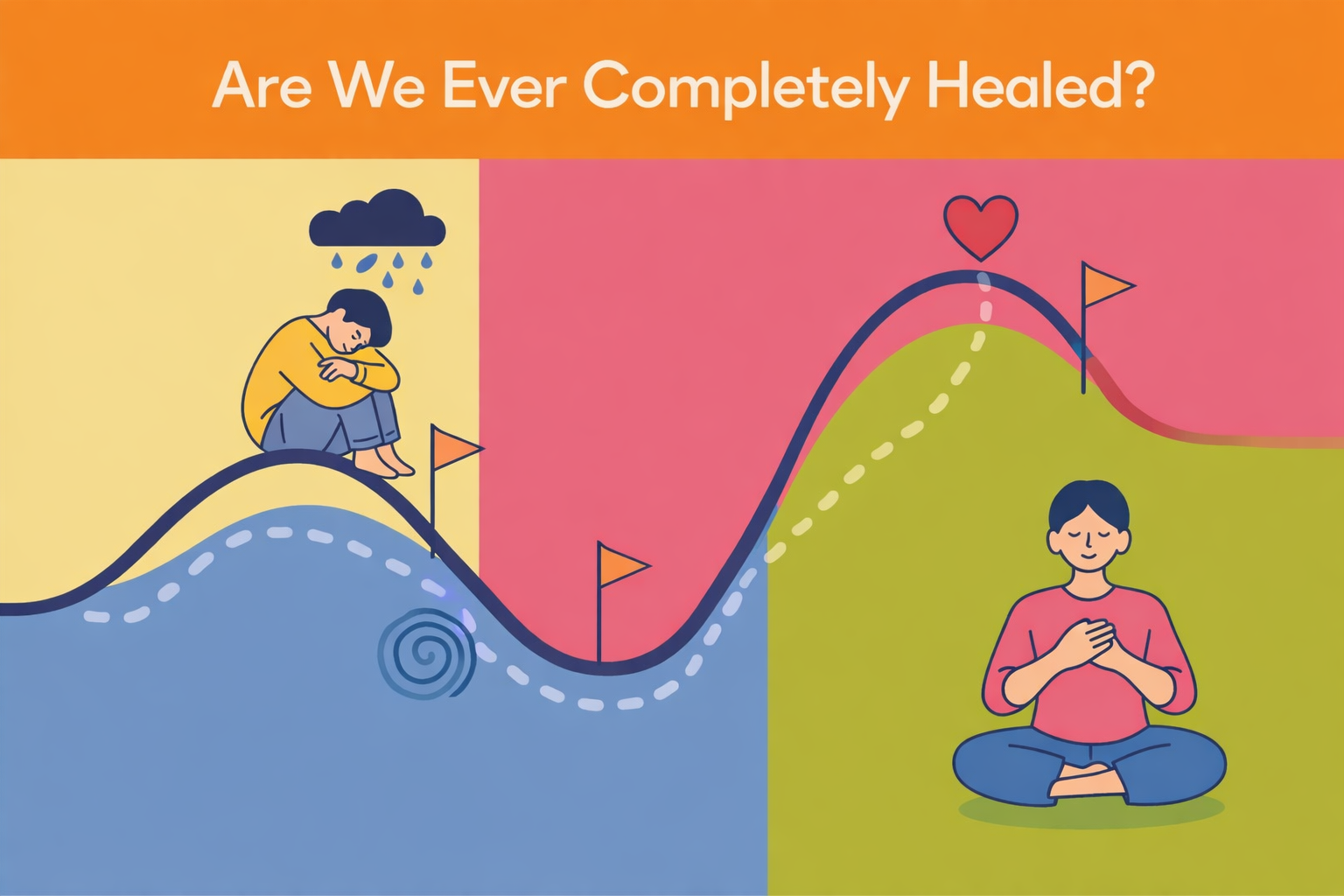
Are We Ever Completely Healed?
One of the most common questions people bring into therapy, which can be sometimes explicitly, sometimes quietly, is this: “Will I ever be fully healed?”
It’s from a place of reaching that final point of wanting to be fixed, and never to revisit the pain, which makes sense, but, sadly, that’s not what healing is.
This question doesn’t come from weakness or impatience, but rather, from something deeply human. We are wired to think in binaries: sick or healthy, broken or fixed, before or after. This “all or nothing” tendency helps us categorise the world quickly, reduce mental effort, and ultimately survive. But when we apply this thinking to something as complex and ongoing as mental health, it can quietly set us up for disappointment, and say if this has happened often, then it might quickly catapult into feeling hopeless as well.
Healing, unlike a broken bone, does not follow a neat timeline. And therapy, despite how it’s often portrayed, is not a cure in the medical sense. This doesn’t make it ineffective, but it makes it honest.
Why We Want Healing to Be Complete
The desire for complete healing often comes from exhaustion. When we’ve lived with anxiety, trauma, depression, grief, or emotional pain for long enough, we, at most times, don’t just want relief, but an end to the pain. We want a future where this no longer reaches us, where triggers don’t exist, and old wounds don’t ache at inconvenient moments.
To top it all, society reinforces this longing. We talk about “recovery journeys” as if they have a finish line. While celebrating “before and after” transformations is important to really acknowledge the hard work we’ve put in, if taken in the “all or nothing” way, it can set unrealistic expectations of that “finish line”.
Mental health doesn’t exist in a vacuum. We don’t stop being affected by relationships, losses, stress, ageing, identity shifts, or unexpected life events, etc. just because we’ve done our work. To expect ourselves to be permanently untouched by future pain is to expect ourselves to stop being human.
Healing as a Process, Not a Destination
A more compassionate way to understand and to approach healing is to see it as an ongoing process rather than a final state. It is not the absence of pain but a change in our relationship with pain.
Someone who has “healed” from trauma may still feel fear, grief, or anger at times, and sometimes it can be really intense too. The difference is not that these emotions disappear, but that they no longer hijack the person’s entire nervous system or the sense of self. Here, we may witness the reactions soften (and more from a place of responding), recovery time shorten, and having more choice in how they respond.
This is why many people feel discouraged when old patterns resurface and assume they’ve gone backwards. When in reality, revisiting pain doesn’t mean failure. It often means deeper layers are being touched. Healing rarely moves in a straight line. It spirals, goes up and down, sometimes upside down, and so rollercoasters are a good analogy for it. We return to familiar themes with more awareness, more tools, and more capacity.
What Therapy Is Actually Meant to Do
With all of this unravelling in one blog post, we may find ourselves asking: “If therapy isn’t meant to cure us completely, then what on earth is it supposed to do?”
To respond to this frustration, I can say that therapy helps to:
- Understand yourself and the parts of you better
- Build emotional literacy and regulation
- Develop healthier coping strategies
- Identify and interrupt harmful patterns
- Strengthen your capacity for relationships
- Create meaning from your experiences
Most importantly, therapy helps expand our window of tolerance, our ability to experience difficult emotions without becoming overwhelmed or shutting down, i.e. our capacity.
Rather than removing pain from our lives altogether, therapy addresses the past pains (especially in the case of trauma), helps resolve them (through offering perspective, facing the pain, etc.) if they are keeping us stuck, and increases our resilience, flexibility, and self-compassion.
This is why therapy doesn’t make us immune to future struggles, but it often makes those struggles less consuming.
The Myth of the “Healed Person”
There is a quiet pressure, especially in mental health spaces, to become the “healed” version of ourselves. The calm one. The regulated one. The one who never spirals, never self-doubts, never gets triggered. But this ideal can become another form of self-judgment fueled by shame.
The truth is, people who have done deep inner work still have bad days. They still grieve deeply. They still feel insecure at times. They still struggle in relationships. This is because it is human to do so.
So, a healed person is not someone who no longer hurts; it’s someone who knows how to care for themselves when they do.
Healing Until the End of Life
Healing doesn’t stop at a certain age or milestone. It evolves as we evolve. Different stages of life bring different psychological, emotional, etc. tasks, such as identity, belonging, intimacy, purpose, loss, and meaning, where each stage may activate unresolved parts of us, not because we failed before, but because life is asking something new of us.
Even people who have lived relatively stable lives may find themselves confronting anxiety, grief, or existential questions later on. This doesn’t negate previous healing, but it builds on it.
If we are able to really see healing in this perspective, then it becomes less about “arriving” and more about staying in a relationship with yourself across the twists and turns of life.
Letting Go of the Finish Line
When we let go of the idea that healing must be complete, something softens. We stop measuring ourselves against an impossible standard and allow ourselves the grace to stop asking, “Why am I not over this yet?” and start asking, “What do I need right now?”.
This shift doesn’t make pain easier, but it makes it less lonely and less shameful.
You don’t need to be perfectly healed to live a meaningful, connected, fulfilling life. You don’t need to eliminate every wound to be worthy of love, joy, or rest. Healing is not about becoming someone else, but about becoming more of yourself, aligning with who you are.
Perhaps the most radical and human part of healing is accepting that it doesn’t end, not because we are broken, but because we are alive.